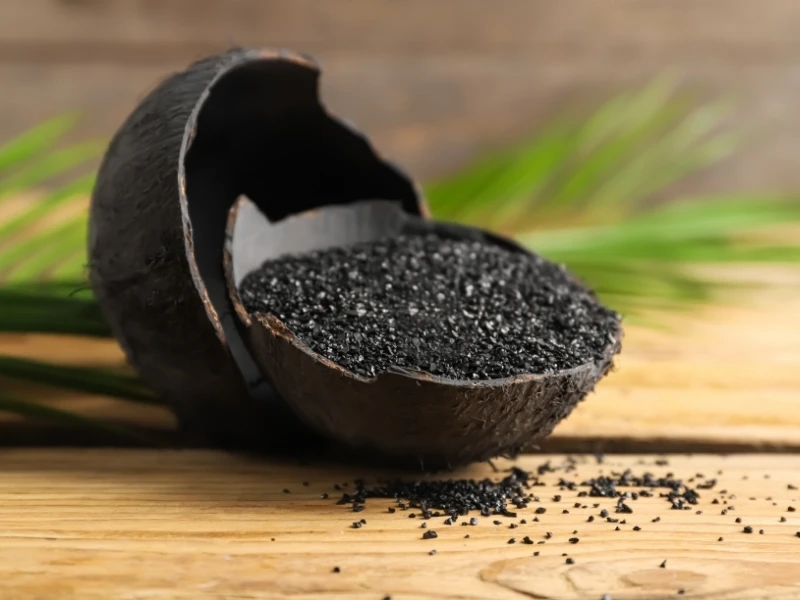
Hazelnut shell is the hard outer shell separated from the kernel during cracking. It appears after every harvest in the Black Sea and was treated as "waste" for many years. Today it is a product with its own technical card, its own buyer segments and its own price dynamic.
This article gathers in one place what raw hazelnut shell is and who buys it and why.
Where the shell comes from: the yield question
How much of in-shell hazelnut is shell is determined by yield. TMO's purchase prices are built on a 50% sound kernel basis; that is, roughly 1 tonne of in-shell hazelnut leaves about half a tonne of shell.
The estimated in-shell crop announced by Ministry of Agriculture and Forestry commissions for 2026 is 704,195 tonnes. This theoretically means a shell potential on the order of 340,000–350,000 tonnes. But not all of it reaches the market: some is consumed on-site for the cracking plants' own heat needs, some stays in the village, and some does not meet the industrial specification because it is mixed with soil and stone.
What the market values is not raw shell but sieved, dried, single-origin raw shell.
Technical card
The shell's industrial value comes from its chemical structure. Hazelnut shell is a lignin-rich lignocellulosic material; in the literature the lignin ratio is mostly given in the 35–40% band; in hardwoods this ratio is typically 20–25%. Lignin is the source of both energy density and hardness.
| Parameter | Typical value |
|---|---|
| Higher heating value (HHV) | ~18–19 MJ/kg (≈4,400–4,600 kcal/kg) |
| Lower heating value (LHV) | ≈3,950–4,400 kcal/kg |
| Ash | 1–3% |
| Moisture (dry stock) | 5–9% |
| Volatile matter | ~70%+ |
| Fixed carbon (raw) | ~19% |
| Sulphur / chlorine | low |
| Bulk density | on the order of ~300 kg/m³ |
These values are the measurement bands in the literature; they vary with origin, variety, drying and storage conditions. Exact batch-level values are stated by analysis.
In comparative studies on hard-shelled fruit residues, higher heating values have been reported in the 17.75–19.12 MJ/kg range; another measurement on different hazelnut varieties found a 17.21–18.42 MJ/kg band and a 0.89–1.4% ash ratio. So the 18–19 MJ/kg band is not a marketing sentence but the average of the measurement literature.
It is also a defined item in international classification: ISO 17225-1 positions hard-shelled fruit residues under the heading of fruit biomass. Spain's UNE 164004 standard directly defines hazelnut, almond, walnut and pistachio shells with quality classes.
Raw shell, pellet and carbonized shell are not at the same calorie
This is the most-confused matter in the sector:
| Product | Difference in energy terms |
|---|---|
| Raw hazelnut shell | Its typical higher heating value is in the ~18–19 MJ/kg band. |
| Hazelnut shell pellet | Pelleting mainly changes the form and bulk density; the per-kilogram heating value stays close to raw shell. |
| Carbonized shell | A significant part of the moisture and volatile components is removed, fixed carbon rises; the per-kilogram heating value can be markedly higher than raw shell. |
| Activated carbon | Evaluated not by fuel calorie but by surface area, pore distribution, hardness and adsorption performance. |
It is not correct to give a single, fixed calorie figure for carbonized shell. The result varies with carbonization temperature, residence time, remaining volatile matter, ash and final moisture ratio. The commercial value must be stated by the laboratory analysis of the relevant batch.
Who buys it
The buyer profile of raw shell is wider than supposed:
Greenhouses. In regions without a natural-gas line, automatic-feed solid-fuel boilers in greenhouses run on shell. Balanced overnight heat and low ash are this segment's two basic expectations.
Bread, pide and industrial ovens. Long-lasting embers and low soot are the reason for preference in stone ovens.
Industrial steam and hot-water boilers. The 1–3% ash band shortens the downtime set aside for grate and tube cleaning; the real saving often appears here.
Biomass power plants. It builds a plannable line for facilities drawing high tonnage year-round.
Pellet and briquette producers. As raw material in densified-fuel production.
Charcoal producers. Carbonized and ground, it turns into shisha and barbecue charcoal briquettes.
Blasting workshops. Ground shell is a softer, silica-free abrasive compared to silica sand.
Livestock operations. After suitable sizing and de-dusting, it is used in barn and coop bedding.
Landscaping and agriculture. As mulch and soil conditioner.
Activated carbon and the chemical industry. The highest value-add channel.
The shell's real competitive advantage: ash
When comparing shell with coal, most people look at heating value. Yet the difference mainly arises on the ash side.
The ash ratio, which can rise to the 15–30% band in lignite, stays at 1–3% in shell. Its practical equivalent: less slag, less boiler and flue cleaning, fewer unplanned stops, less disposal. When these items are summed at year-end, a comparison made on price per kilogram becomes misleading.
The right comparison measure is this: how much does each 1,000 kcal entering your boiler cost you?
The limits of raw shell; and the pellet answer
Raw shell has two physical constraints:
Low bulk density. A density on the order of ~300 kg/m³ causes long-distance transport to hit the vehicle's volume limit, not its weight limit. Freight is calculated per m³, not per tonne.
Irregular particle geometry. As noted in the literature, the irregular shape of shell can make it harder for air to distribute evenly within the fuel bed; this can increase CO and hydrocarbon emissions from incomplete combustion in some systems.
Both constraints have an answer in the same direction: densification, i.e. pelleting. Raw shell comes out ahead over short distances and in large grate boilers; pellet comes out ahead over long distances, in automatic-feed and emission-sensitive systems. For a detailed comparison: Raw shell or pellet?
Product form and packaging
The shell can be shipped in the raw (broken) form at the cracking exit and can also be prepared ground to request. Grinding has two reasons: process requirement (blasting mesh range, pellet feedstock, uniform landscape appearance) and logistics requirement; as particle size shrinks, bulk density rises, and more product fits in the same bag and the same vehicle.
Let us clarify a frequent confusion in packaging choice: a bag's carrying capacity and the amount of product that fits inside it are not the same thing. Because unground shell is bulky, it does not reach 1,000 kg in a standard big-bag. When grinding is done, bulk density rises and more product fits in the same bag. That is why an order is spoken of not by bag count but by net tonnage.
Supply logic
Raw shell is a product with a season. The harvest is in August–September, the peak of the cracking season is between October and February. Heating demand, meanwhile, peaks in November; so the period of most abundant supply coincides with the period of highest demand.
For an operation with a set annual tonnage, the right move is to lock the purchase at the start of the season and to build storage capacity by volume, not by weight.
Supply and logistics conditions on the Ordu, Giresun and Sakarya line are decisive in forming the delivery cost. If your delivery province is near the east, the Ordu–Giresun wing comes in; if near the west, the Sakarya wing.
Not waste, but a reclaimed agricultural resource
Hazelnut shell is not the trunk of a tree felled to make charcoal. It is an agricultural by-product that appears after the kernel is separated. Turning it into energy or industrial raw material means re-evaluating an existing biomass flow. Its low-sulphur and low-ash potential is also among its technical advantages over fossil solid fuels; exact values are confirmed by batch analysis.
Our working model: the hazelnut shell integrated approach
We do not see hazelnut shell merely as a fuel to be bought and sold. From the intake of raw shell through sieving, sizing, grinding, moisture control and packaging; from there to carbonization, pellet, briquette, activated carbon and non-fuel-use research, we handle the value chain as a whole.
In the sector, many investments are planned around machinery and the final product; the variability of the raw material is not taken sufficiently into account. Yet a raw material whose moisture, particle size, dust ratio, foreign matter, density and degree of carbonization change cannot be expected to give the same result in every batch with the same recipe. Recipes not holding and line stoppages often begin at this point.
So instead of offering a single uniform product for every process, we are open to developing a specification according to the customer's line: the requested particle distribution and grinding degree, moisture ratio, packaging form, batch size and shipment plan can be defined together. Target values are first confirmed by sample and analysis; then turned into a repeatable supply standard. Not an unconditional promise but a verified standard.
Sources: Ministry of Agriculture and Forestry 2026 crop-assessment study; TMO 2026/27 in-shell hazelnut purchase terms; ISO 17225-1:2021 Solid biofuels; Fuel specifications and classes; UNE 164004:2022 Biocombustibles sólidos; Cáscaras de frutos secos; published comparative studies on the thermochemical characterisation of hard-shelled fruit residues.
Share your boiler consumption or process goal, and let us determine the suitable product form and tonnage together: get a quote.
Related content
- What Determines the Ton Price of Hazelnut Shell?
- Switching from Coal to Hazelnut Shell: How to Run the Numbers
- One Shell, Five Different Buyers
- The Ordu–Giresun–Sakarya Line: Why Shell Comes from Here
- What We Put in the Shipment
- Raw Hazelnut Shell; product details
Frequently Asked Questions
Which operations is raw hazelnut shell suitable for?
Greenhouses, stone ovens, industrial boilers and biomass plants; also pellet and briquette production, charcoal (hookah/barbecue), blasting, animal bedding and activated-carbon feedstock.
In what forms can I buy the product?
Raw (crushed) as it leaves the cracker, or ground to request; processed channels such as pellets, briquettes, carbonized product and activated-carbon feedstock are also available.
What are the heating value and moisture?
Higher heating value is around 18-19 MJ/kg, ash 1-3%, and moisture 5-9% in dry stock. These are literature bands; exact per-batch values are stated by analysis.
Ready to Explore?
Plan your next order with Fındıkkabuğu and see the difference yourself!
Browse Our Products