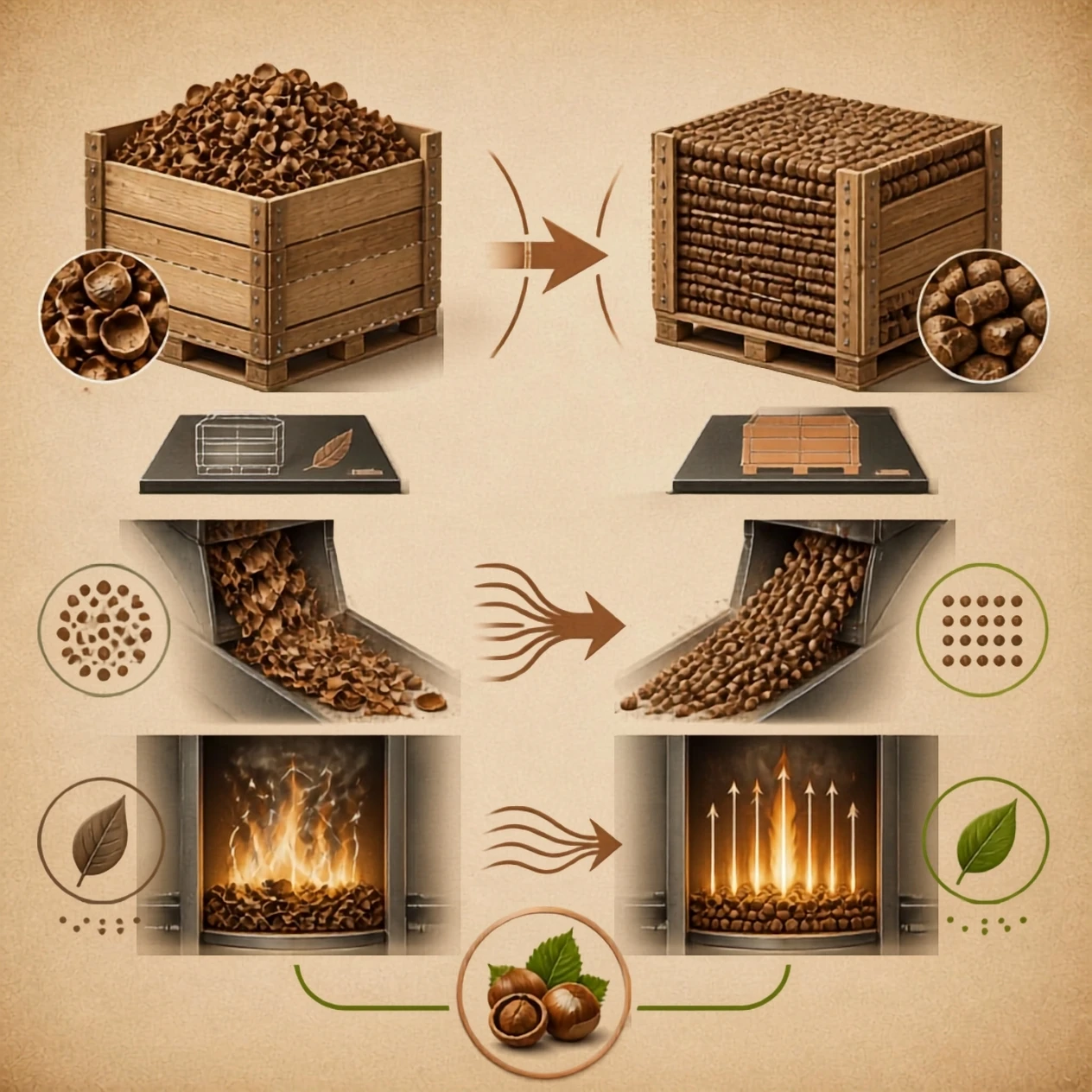
The difference between raw hazelnut shell and hazelnut shell pellet is not chemical but physical. Both have the same heating-value band, come from the same raw material, carry the same lignin. What changes is form; and form turns directly into money in three places.
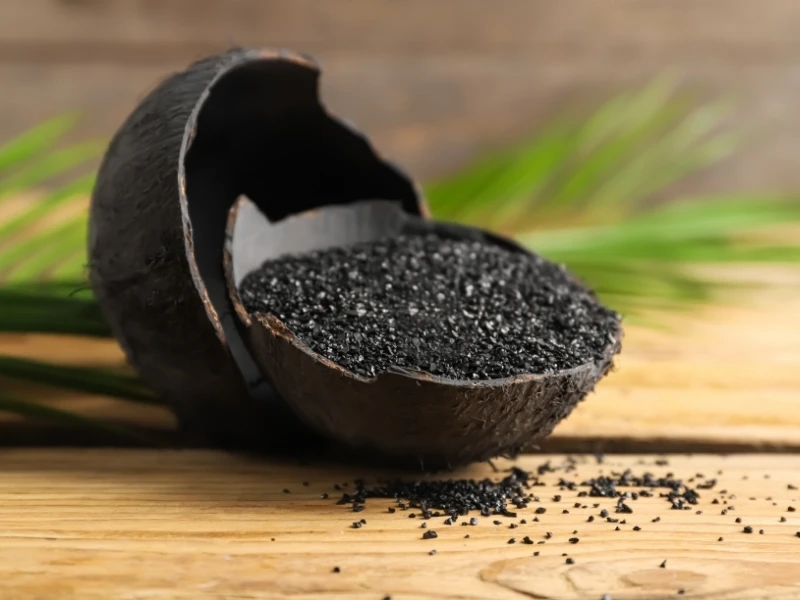
Carbonised shell is not included in this comparison. Carbonisation is not physical shaping but a thermal process that changes the raw material's chemical structure; because volatiles decrease and fixed carbon rises, the per-kilogram heating value of carbonised shell can clearly exceed that of raw shell and pellet. The exact value is determined by process and batch analysis.
Difference 1: Bulk density, i.e. freight
The bulk density of raw shell is on the order of 300 kg/m³. Bulk densities measured for hazelnut-based pellets are reported in the literature in the 550–580 kg/m³ band.
This means roughly nearly twice the energy in the same volume.
It is easy to see why this matters through a vehicle: shell is a light, bulky load and on most shipments it hits the vehicle's volume limit, not its weight limit. So the vehicle looks full but carries little energy.
Practical results:
- Over short distances raw shell comes out ahead. The densification cost can exceed the saving from freight.
- Over long distances and in export pellet comes out ahead. It carries markedly more kcal on the same vehicle.
- In storage pellet comes out ahead. Much more energy fits in the same silo; for operations with limited enclosed space this alone can be decisive.
Difference 2: Feed continuity
When raw shell is sieved (5–20 mm) it flows smoothly in stoker systems. But its particle-size distribution is inherently wide; when the dust ratio rises, bridging can occur in the feed line.
Pellet, by contrast, is a product of standard diameter and standard length. This means the fuel is genuinely portioned: the amount of energy entering the boiler at each feed step becomes predictable. In automatic-feed and modulated systems this reduces flame fluctuation.
Difference 3: Combustion behaviour and emissions
The least-discussed but technically most important difference in the sector.
As shown in the literature, the irregular particle geometry of raw shell makes it harder for air to pass evenly through the fuel bed during combustion. In some regions of the bed oxygen becomes insufficient; this can increase CO and various hydrocarbon compounds from incomplete combustion.
Pelleting mitigates this problem in two ways: the particles become homogeneous and the feed is portioned. The result is a more even bed and more complete combustion.
It is clear for whom this difference matters: facilities subject to emission measurement, indoor and residential-type systems, modulated modern boilers. In large grate-type industrial boilers with flexible air adjustment, raw shell works without trouble.
Comparison table
| Raw shell | Pellet | |
|---|---|---|
| Heating value (HHV) | ~18–19 MJ/kg | similar band |
| Bulk density | ~300 kg/m³ | ~550–580 kg/m³ |
| Particle homogeneity | low | high |
| Feed | stoker-compatible, dust risk | portioned, predictable |
| Storage volume | high | low |
| Long-distance freight | disadvantaged | advantaged |
| Unit cost | lower | processing cost added |
| Emission control | system-dependent | easier |
Which suits you?
Choose raw shell if:
- You are close to the production region
- You have a grate-type industrial boiler with flexible air adjustment
- You have wide enclosed storage space
- Unit cost is your priority
Choose pellet if:
- You are at a long distance or you export
- Your storage space is limited
- You have an automatic-feed, modulated system
- You are subject to emission measurement
- You sell the fuel bagged to the end user
Same raw material, two products
Raw shell and pellet are born from the same raw material; they answer different needs. Raw shell can be prepared directly or ground to request. In pellet production the raw material passes through sizing, moisture adjustment and densification stages; for the technical detail of these stages: How are hazelnut shell pellets produced?
In a pellet investment, focusing only on press capacity and die size is not enough. When the hazelnut shell bought under the same name changes in moisture, particle distribution, dust, kernel residue and foreign matter, friction, compression behaviour and pellet durability change too. Applying a fixed recipe with non-standard raw material forces the producer into constant re-adjustment and unexpected stoppages.
So the answer to "which do you want to sell?" is not ours; the right question is: which one does your boiler want?
Sources: published studies on the evaluation of hazelnut shell as pellet feedstock (bulk density, combustion behaviour and emission findings); published measurements on the quality characterisation of hazelnut-based pellets; ISO 17225-1:2021 and ISO 17225-6 solid biofuel classification; ISO 17828 bulk density determination.
Write your boiler type and let us determine together which form is suitable: get a quote.
Related content
- What Is Raw Hazelnut Shell and What Is It Used For?
- Hazelnut Shell Pellet Fuel
- Raw Hazelnut Shell; product page
Frequently Asked Questions
Pellet or raw shell?
Choose pellets for long distance, tight storage, automatic feeding or emission-sensitive systems; raw shell suits large grate boilers close to the production region.
What advantage do pellets offer over raw shell?
At a bulk density of roughly 550-580 kg/m³ it fits nearly twice the energy into the same volume; freight drops over long distances and storage efficiency rises in tight silos.
Which systems are pellets suitable for?
They suit automatic-feed and modulated boilers; the standard particle gives portioned, predictable feeding, and a homogeneous bed makes emission control easier.
Why is pre-treatment needed?
High lignin (~35-40%) gives low degradability raw; thermal pre-treatment raises methane yield 2-4 times in the literature. Values vary with conditions and mix.
Ready to Explore?
Plan your next order with Fındıkkabuğu and see the difference yourself!
Browse Our Products