It is no accident that shisha charcoal gives steady heat for a long time. That stability is the result of the transformation the shell undergoes in the kiln and the briquetting recipe that follows.
Why hazelnut shell?
Good feedstock for carbonization wants two things: density and lignin.
The lignin ratio in hazelnut shell is mostly given in the literature in the 35–40% band; above that of most hardwoods. Lignin is the component that, when heated, preserves the carbon skeleton instead of breaking apart. That is why charcoal obtained from shell can be denser and less brittle than that from light wood.
In the proximate analysis of the raw material, the fixed-carbon ratio is around 19%; most of the rest is volatile matter. The job of carbonization is to remove these volatiles and leave the fixed carbon behind.
Stage one: carbonization
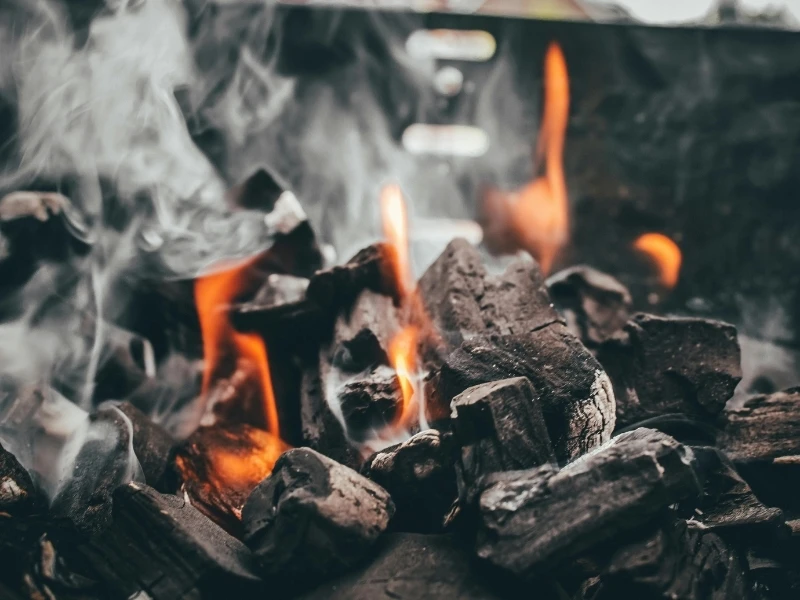
The shell is heated in an oxygen-free or oxygen-limited environment. This process is called pyrolysis. As the temperature rises, first moisture, then resins and volatile organic compounds separate off; what remains is a carbon-rich, porous solid.
The temperature choice determines the product:
- 400–500 °C: Yield is high, but the volatile matter may not have fully departed. Insufficiently carbonized charcoal smokes and soots when burned.
- 600–800 °C: High fixed carbon, low volatiles. This is the targeted band for barbecue and shisha.
- Higher temperatures: Can change the pore structure and volatile-matter ratio. But merely raising the temperature does not make the product activated carbon; activated carbon requires controlled physical or chemical activation.
If carbonization is done well, the broken surface of the piece is matte black throughout. If a brown, woody core remains inside, the job is half done.
Carbonization does not only change the colour; it also changes the energy density. While raw shell is in the ~18–19 MJ/kg higher-heating-value band, in carbonized shell the per-kilogram heating value rises as volatiles decrease and fixed carbon increases. But a single fixed figure cannot be used for the carbonized product; temperature, residence time, remaining volatile matter, ash and final moisture must be measured together.
Stage two: grinding, mixing, pressing
The carbonized shell is passed through crushers and sieves and reduced to powder. It is then mixed with a binder; the most common binder in the sector is starch, typically run in the mixer at low ratios with water until a homogeneous mix is obtained.
One of the critical variables of this stage is moisture. The suitable ratio is determined by trial, according to raw-material particle size, binder, press type and target briquette geometry. Too dry a mix does not hold sufficiently in the mould; too wet a mix can adversely affect shape stability and drying time.
The mix is poured into moulds and compressed under pressure. The hexagonal form with a central hole in shisha charcoal is not merely aesthetic; the hole feeds airflow from the centre, helping the piece light more evenly from inside out. The briquettes leaving the press reach transportable strength after drying.
It must be underlined: the formula of barbecue and shisha charcoal is not the same. The targeted ignition speed, burn time and odour profile differ between the two products; even if they come off the same line, their recipes diverge.
The recipe works on a standard raw material
The right recipe alone is not enough. If the carbonized raw material's moisture, fixed carbon, volatile matter, ash, particle size, pore structure and grinding behaviour vary from batch to batch, the same binder solution and the same press setting do not give the same result.
Initial moisture determines the usable range of the recipe. If the carbonized raw material carries more moisture than needed, the absorption and process margin required for the water-based binder solution narrows. Because some of the pores are already filled with water, the solution's distribution into and onto the particle can change. When the producer adds the same amount of solution, the mix can stay too wet; when the solution is reduced, sufficient bonding may not form. So not only the final mix but also the raw material's moisture must be standardised before the binder is added.
Carbonization must standardise the pore structure. What matters here is not only the number of pores but the total pore volume, pore-size distribution, accessible surface and surface chemistry. Insufficient pore and surface contact limits the binder's grip. An overly absorbent structure, on the other hand, can pull the binder solution into the pores and reduce the amount of effective binder that would form a film and bridge between particles. The target is not the least or the most pores but a suitable pore structure where the chosen binder grips in a controlled way and bridges sufficiently between particles.
Excess binder has a cost. A producer working with non-standard raw material tends to raise the binder ratio to reduce the risk of breakage and disintegration. This can increase durability in the short term; but it can lower the carbonized-raw-material ratio and fixed-carbon share, raise the volatile matter, change ignition and odour behaviour, and create direct cost. The ash increase depends on the binder's type and mineral content: starch is an organic binder; with mineral or inorganic binders the ash increase can be far more pronounced. So "more binder" does not always mean "better charcoal".
In this area, alongside carbonized-product supply, we work on defining together the initial moisture, degree of carbonization, grinding range and pore-structure targets. The target specification is first confirmed by sample production and analysis; when a suitable result is obtained, a regular batch standard and delivery plan are established.
Where quality is read
Ash colour. The ash of good shisha charcoal is white–light grey. Dark, blackish ash points either to incomplete carbonization or to foreign matter in the raw material.
Ash ratio. Low ash means both a cleaner burn in the bowl and less cleaning on the service side.
Odour and taste. Because a charcoal whose pyrolysis process is complete carries no residual volatiles, no smoky taste passes to the product. In shisha, this means the tobacco aroma is not spoiled.
Spark and cracking. A pressed briquette sparks less than natural lump charcoal. It is a safety item for indoor venues.
Burn time and homogeneity. Uniform-sized pieces build a predictable heat bed.
For producers selling to the European market, the reference standard for barbecue charcoal is EN 1860-2; a line targeting export must plan certification from the outset.
Completing the cycle
Hazelnut shell is a waste stream. As long as there is a harvest, it appears without anyone having to fell a tree for it. This makes shell not only an economical but a defensible choice on the HoReCa side.
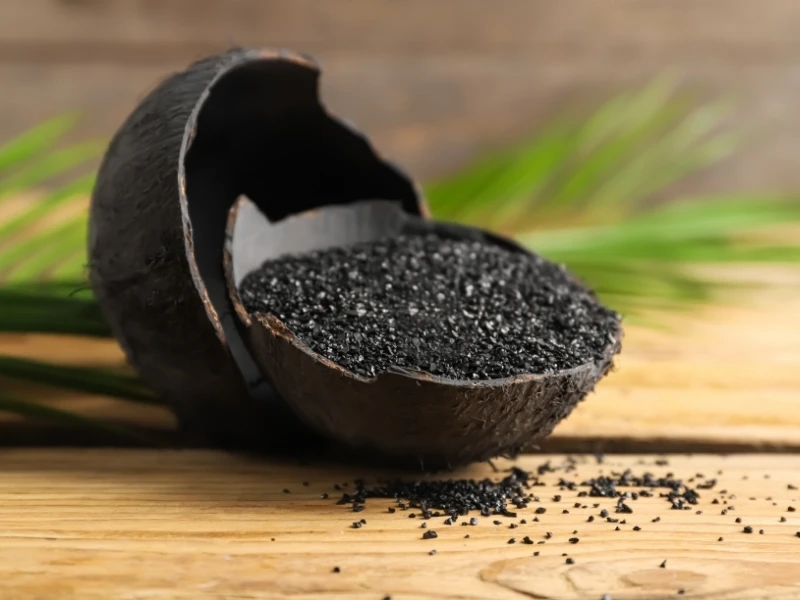
The comparison is not limited to wood charcoal. Coconut shell charcoal is a strong benchmark in the global market with low ash and long burn performance. Positioning hazelnut shell charcoal at this level requires managing controlled carbonization, standard particle size, the right binder, and density, ash, odour and burn-time tests together. The aim is to develop, from an agricultural by-product, a consistent charcoal that can compete with international products.
Sources: Lomunyak et al. (2024), the effect of starch binder ratio on the strength and fuel properties of charcoal briquettes; Aransiola et al. (2019), the effect of binder type, concentration and pressing pressure on briquette properties; Saeed et al. (2021), the effect of initial moisture on briquette properties; Ayaa et al. (2025), the effect of binder ratio on fixed carbon, volatile matter and heating value; studies on the proximate analysis and pyrolysis characterisation of hazelnut-shell biochar; EN 1860-2 barbecue charcoal standard.
For carbonized shell, briquette raw material and product-development requests, get in touch.
Related content
- Technical Values and Applications
- Non-Fuel Channels: One Shell, Five Different Buyers
- Shisha Charcoal; product page
- Barbecue Charcoal; product page
Frequently Asked Questions
How do you know carbonization is complete?
If the broken surface is matte black throughout, it is done; a brown woody core means half-carbonization; confirmed by sample and analysis.
Why should the ash be white?
White–light grey ash signals full carbonization and low impurities; dark ash means incomplete pyrolysis or foreign matter; confirmed first by sample and analysis.
Why are pressed briquettes preferred?
Uniform pressed pieces build a predictable heat bed and spark less than natural lump; a fully pyrolyzed product leaves no smoky taste.
Why does the holed hexagonal form matter?
The hexagonal form with a central hole feeds airflow from the centre, so each piece lights evenly from inside out and gives a steadier heat.
Ready to Explore?
Plan your next order with Fındıkkabuğu and see the difference yourself!
Browse Our Products