Most demand for raw hazelnut shell comes from the energy side. But not the entire buyer list burns it; and those who don't usually pay more per kilogram.
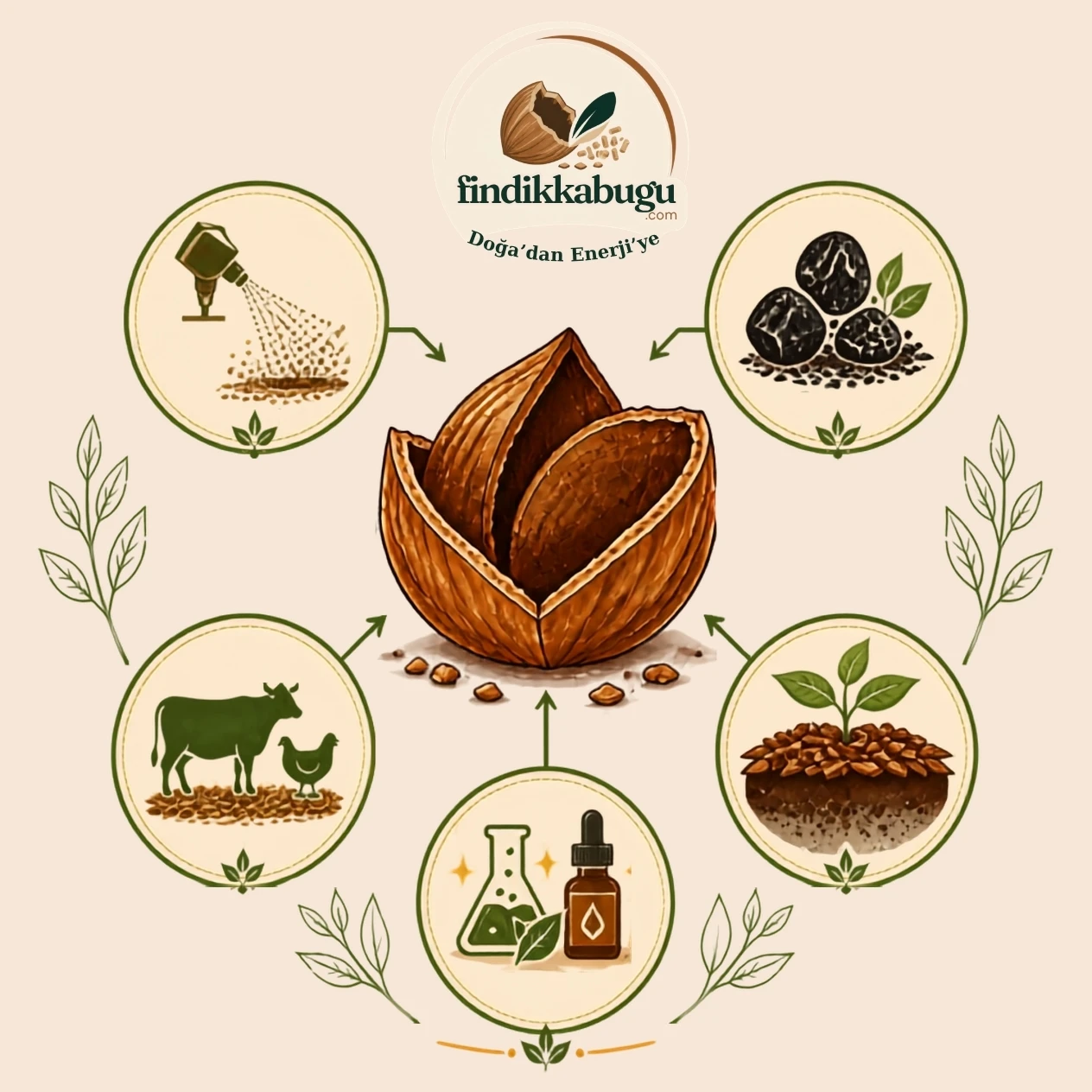
This article covers five different channels for the same raw material and why each prefers shell.
1. Blasting: a natural alternative to silica sand
Ground hard shell falls into the soft-abrasive group for industrial surface cleaning. This group's Mohs hardness is typically in the 3–4 band; for comparison, silica sand (quartz) is 7.
What this means: at the right mesh, pressure and application conditions, shell granules can remove oil, grease, carbon build-up, light paint and surface oxidation without treating the base surface as aggressively as silica sand. Surface compatibility should be tested on a small area before application.
Applications:
- Historic facade and stone-surface cleaning, graffiti removal
- Paint stripping from wood and composite surfaces
- Engine and turbine part cleaning
- Delicate metal surfaces
The real issue is health. Blasting with silica sand carries a silicosis risk from crystalline silica dust and is restricted or banned in many countries. Türkiye is a country that experienced the consequences of this risk heavily in the textile sector. Organic shell abrasives are silica-free and usually produce less dust; this is a worker-health item before it is a cost item.
Shell is also naturally absorbent; it can lift oil from the surface during blasting as well.
What this channel wants: product ground to specific mesh ranges, de-dusted and dry.
2. Activated carbon: the shift to a porous state
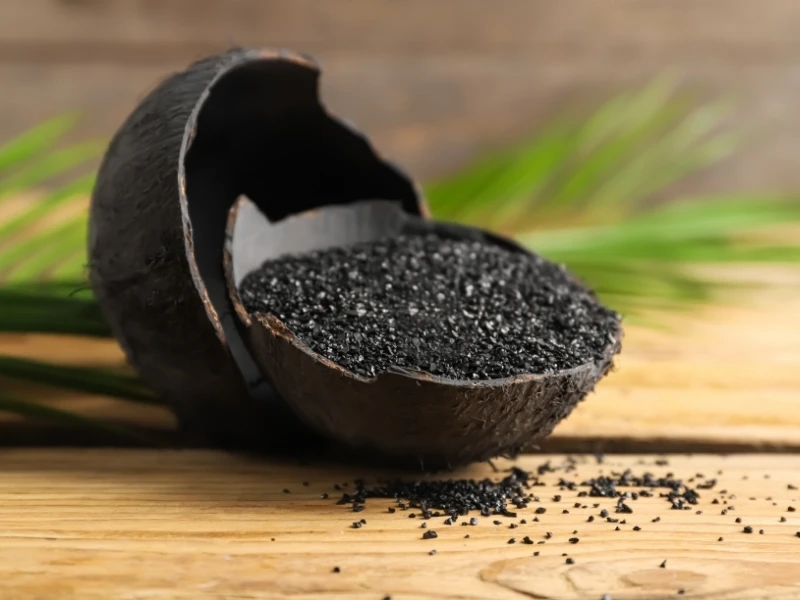
The highest value-add channel. In a particular study, the BET surface area of raw hazelnut shell was measured at about 1.68 m²/g, while the surface area of a sample slowly pyrolyzed at 900 °C was 666 m²/g. These values vary with the properties of the shell used, the heating rate, the residence time and process conditions.
Three properties make shell a good precursor:
- High lignin (35–40% band). Lignin-rich precursors can offer an advantage in carbonization yield and carbon-skeleton formation.
- Low ash. In activated carbon, ash is dead weight that occupies pore volume.
- Regular, domestic supply. Compared to imported coconut shell, logistics cost and supply risk are low.
Applications have been widely studied in the literature: removal of heavy-metal ions from aqueous media, textile dyes, antibiotic residues, capture of volatile organic compounds and oil treatment. For detail: Hazelnut shell as activated-carbon raw material
What this channel wants: single-origin, sieved shell low in foreign matter. When hazelnut, walnut and peanut come mixed, each batch yields a different pore structure; unacceptable in serial production.
3. Animal bedding
The structure of shell, when properly cleaned and sized, can be used in barn and coop bedding applications. Moisture management and service life depend on particle size, dust ratio, animal type and bedding-renewal frequency.
What this channel wants: de-dusted, dry product with a low sharp-particle ratio. Price sensitivity is high and volume demand is regular.
4. Landscaping: mulch and soil conditioner
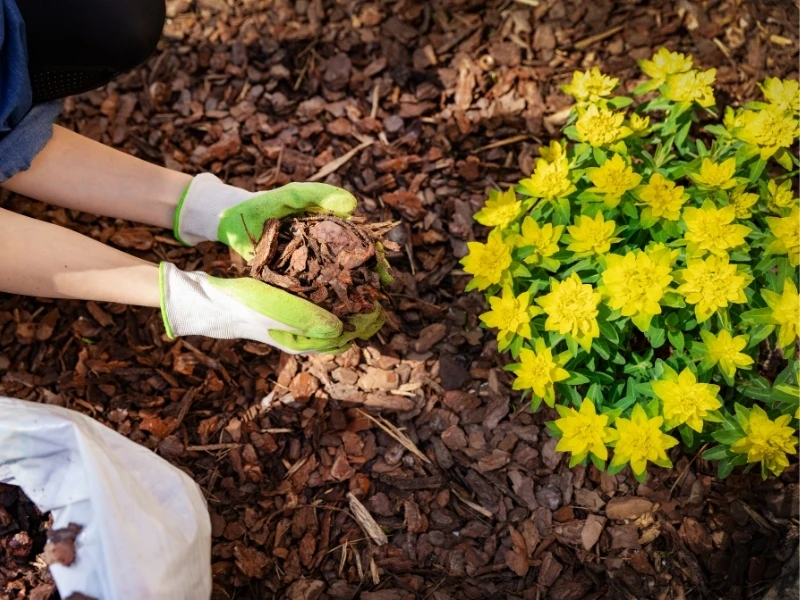
The properties that make shell valuable as fuel; high lignin, hard and dense structure; also serve as mulch. Microorganisms struggle to break down this structure; this helps hazelnut shell decompose more slowly than many organic mulches. Service life varies with climate, irrigation, layer thickness, particle size and how much the surface is disturbed.
Its ground or composted form improves aeration and drainage when worked into the soil. Research in Türkiye has studied the effects of biochar produced from hazelnut shell on the soil's organic-matter and nutrient-element content. For detail: Hazelnut shell mulch usage guide
What this channel wants: uniform particle size, clean appearance, warm colour tone. Aesthetics is a technical criterion here.
5. Chemistry and cosmetics: shell extracts
The least-known channel. Hazelnut shell is a polyphenol-rich by-product. Studies have reported that the shell's total polyphenol, flavonoid and antioxidant capacity is markedly higher than the kernel's; dominant compounds include gallic acid, kaempferol, quercetin, rutin, chlorogenic and ferulic acid.
Through green processing methods such as autohydrolysis, these compounds can be solubilised and recovered with resins. The literature shows that the resulting extracts draw interest as natural antioxidants in the cosmetics, pharmaceutical and food industries.
Two concepts must be separated here. The classic hazelnut oil used in cosmetics is Corylus avellana seed oil, obtained from the kernel; it cannot be said that the same oil is obtained directly from the hard shell. The cosmetic potential of hazelnut shell lies in the phenolic and other bioactive extracts recovered from the shell. For cosmetic use, the extraction standard, purity, safety and formulation tests must also be completed.
What this channel wants: the highest purity. Origin traceability, low foreign matter and contamination-free storage are essential.
The common denominator: shell quality
All five channels want the same three things:
- Single origin; mixed shell gives repeatable results in no channel
- Sieving and the right particle size; soil and stone raise the ash ratio, wrong size raises process risk
- Dry storage; moisture is a loss of value on both the fuel and the material side
So the difference between "fuel shell" and "industrial shell" is not a different product; it is the same product processed with different care. Whichever channel you work for, it is enough to state your target particle size and moisture expectation from the outset.
Sources: industry documentation on abrasive-media hardness and silica-sand restrictions; published studies on the BET characterisation and adsorbent performance of hazelnut-shell biochar; academic literature on phenolic-compound extraction from hazelnut shell and autohydrolysis; Oregon State University Extension organic-mulch guide; published study on the effect of hazelnut-shell biochar on soil nutrient content.
Whichever channel you seek supply for, write your specification: get a quote.
Related content
- From Shell to Ember: The Carbonization and Briquetting Story
- What Is Raw Hazelnut Shell and What Is It Used For? Technical Values and Applications
- Raw Hazelnut Shell
Frequently Asked Questions
Which applications is it used in?
It is used for historic facade and stone cleaning, graffiti removal, paint stripping from wood and composites, engine and turbine parts and delicate metal surfaces. Surface compatibility is tested on a small area first.
What does the soil conditioner do?
Ground or semi-composted shell improves drainage and aeration when worked into the soil; its hard, irregular geometry keeps it from compacting into a cake.
Which sectors is it suitable for?
Phenolic extracts recovered from the shell are considered as natural antioxidants in cosmetics, pharmaceuticals and food. Extraction, purity, safety and formulation testing are completed on the user side.
Why is hazelnut shell a good activated-carbon precursor?
High lignin (~35-40%) gives a carbon-skeleton advantage, low ash (1-3%) reduces dead weight, and supply is domestic and regular; logistics cost and supply risk are lower than imported coconut shell.
Ready to Explore?
Plan your next order with Fındıkkabuğu and see the difference yourself!
Browse Our Products