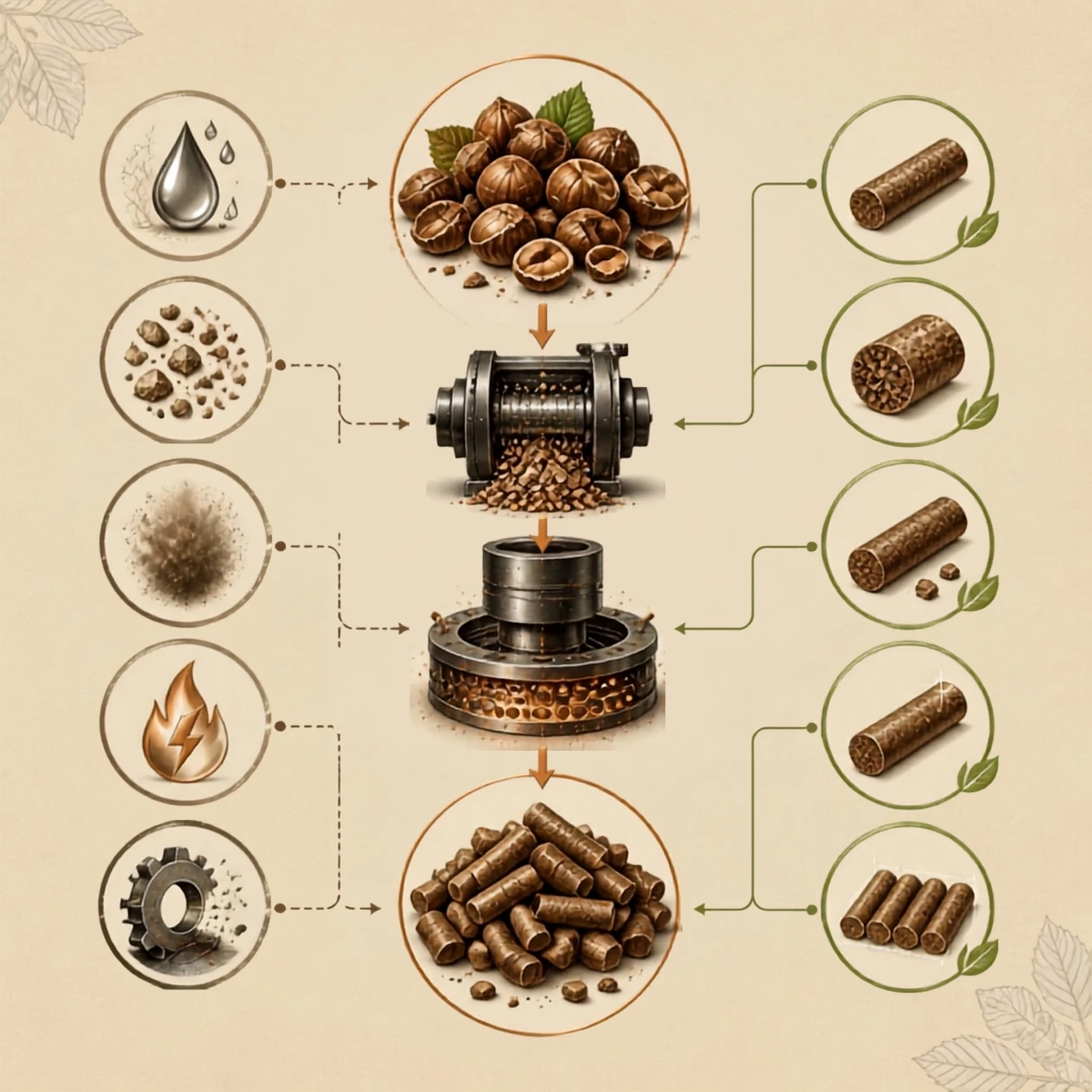
Pelleting hazelnut shell is not like pelleting sawdust. The source of the difficulty is interesting: the properties that make shell a good fuel also make it a hard-to-pellet raw material.
This article explains how the process actually works and which thresholds determine quality.
Why it is hard: the lignin paradox
The lignin ratio in hazelnut shell is mostly given in the literature in the 35–40% band; in hardwoods this ratio is typically 20–25%. Lignin can act like a natural binder in pelleting; softening under the heat and pressure the press produces and locking the particles together.
The problem is in the shell's hardness and rigidity. Sawdust is a fibrous, compressible material; shell behaves much more rigidly. When not sufficiently reduced, the particles do not lock together and the product leaving the press falls apart.
This is not merely a theoretical difficulty. In the literature, press-clogging problems have been reported at ratios above 15% by weight in blends of hazelnut shell with pine sawdust. So shell is not a raw material to "add a little and move on" on a pellet line; it demands its own recipe.
Step 1: Grinding
This is the most decisive step in the process. Studies have shown that to reach acceptable pellet quality, the particle size must be reduced below 1 mm.
This means serious grinding energy and is the fundamental reason pellet cost sits above raw shell. Insufficient grinding cannot be compensated by any intervention in the later steps of the line.
Step 2: Binder selection
Here the literature offers counter-intuitive findings. Different binders have been tried in hazelnut shell pellets, with the following reported results:
| Binder | Reported effect |
|---|---|
| Water | Negative on pellet durability |
| Magnesium stearate | Negative on pellet durability |
| Bentonite clay | Markedly increased durability |
Since adding water is a classic reflex in most biomass, this finding is important; in shell it can work in the opposite direction.
Pellets produced with bentonite clay were also subjected to combustion analysis, and all of them were reported to exceed the 14.5 MJ/kg calorific-value threshold that ISO 17225-6 sets for Class A non-wood pellets.
Note: bentonite is an inorganic additive and pulls the ash ratio up. The amount in the recipe is set by the balance between durability and ash; a point where each line must do its own optimisation.
Step 3: Moisture and pressing
In pelleting, raw-material moisture is the critical variable. Studies on hazelnut-based biomass have stated that keeping raw-material moisture around 10% is suitable for proper pelleting and high durability. Final-product moisture is generally sought at 10% and below in the standards.
If moisture is too low the particles do not lock; if too high the pellet falls apart after leaving the press and degrades in storage.
Where quality is read
The quality of a pellet batch is read in four lines:
Mechanical durability (ISO 17831-1). The pellet's resistance to crumbling during transport and handling. High thresholds are required for the top quality classes in the standards. For comparison: the durability measured in directly-pelleted hazelnut husk did not meet the relevant standard at 89.6%; whereas durability at the 98% level has been reported in properly processed hazelnut-based pellets. The difference is largely process quality.
Bulk density (ISO 17828). Values measured in hazelnut-based pellets are in the 550–580 kg/m³ band. Low density is a disadvantage for both freight and feed predictability.
Ash (ISO 18122). Raw shell's 1–3% ash band is an advantage; but the use of an inorganic binder and soil/stone residue in the raw material raise this ratio. Good pellet does not come from unsieved shell.
Nitrogen and chlorine. In the ISO 17225 classification, the parameter that limits hard-shelled fruit residues is generally not the heating value but nitrogen and ash content. In a comparative study, hazelnut shell samples met Class A2, and walnut shell reached A1.
Which standard to look at
The terminology is often confused:
- ISO 17225-2: Wood pellets. Hazelnut shell is not within this scope.
- ISO 17225-6: Non-wood pellets. Pellets from fruit biomass fall here. This is the correct reference.
- ISO 17225-1: General classification; positions shell as fruit biomass.
- ENplus / DINplus: Certification programmes. ENplus is oriented mainly toward wood pellets; for non-wood pellets the ISO 17225-6 criteria are taken as reference.
A line targeting export must determine its certification route from the outset; fitting the product to a standard after it is out is far harder.
Without a raw-material standard, the recipe does not hold
The most common mistake in pellet investments is looking for the problem on the machine side. Yet when the hazelnut shell bought under the same name varies from batch to batch in moisture, particle distribution, dust ratio, kernel residue, foreign matter and bulk density, a fixed recipe does not give the same result. Friction changes, compression behaviour changes, durability changes.
For this reason we do not limit our role to tonnage supply. By understanding your target product and your line's constraints, we contribute to defining suitable raw-material properties: grinding range, moisture, dust ratio and batch size are set together; target values are first confirmed by sample and analysis, then turned into a regular supply standard.
Summary
Hazelnut shell pellet, when it comes off a properly set-up line, is a fuel that can exceed the ISO 17225-6 Class A thresholds. But this has three conditions: sufficiently fine grinding, the right binder, the right moisture. When one of these three is missing, the product that emerges is pellet-shaped dust.
Sources: published studies on the evaluation of hazelnut shell as pellet feedstock (grinding fineness, binder comparison, ISO 17225-6 compliance); hazelnut-husk pelleting studies; quality characterisation of pellets from hazelnut and olive pruning residues; ISO 17225-1/-2/-6, ISO 17828, ISO 17831-1, ISO 18122 standards.
Raw material or finished-product supply for your pellet line: get a quote.
Related content
- Raw Shell or Pellet? Three Differences Densification Makes
- What Is Raw Hazelnut Shell and What Is It Used For?
- Hazelnut Shell Pellet Fuel; product page
Frequently Asked Questions
How do you guarantee quality?
Values are confirmed by analysis for each batch; moisture, ash and heating value are stated per shipment. A sealed sample is kept for a set period.
Which standard applies?
In Europe the reference standard for barbecue charcoal is EN 1860-2; a line targeting export plans certification from the start. Consistency depends on moisture, fixed carbon, ash and particle size.
Can the particle size be set to request?
Yes. We prepare the product raw (crushed) or ground to request; just state your target particle range.
What advantage do pellets offer over raw shell?
At a bulk density of roughly 550-580 kg/m³ it fits nearly twice the energy into the same volume; freight drops over long distances and storage efficiency rises in tight silos.
Ready to Explore?
Plan your next order with Fındıkkabuğu and see the difference yourself!
Browse Our Products