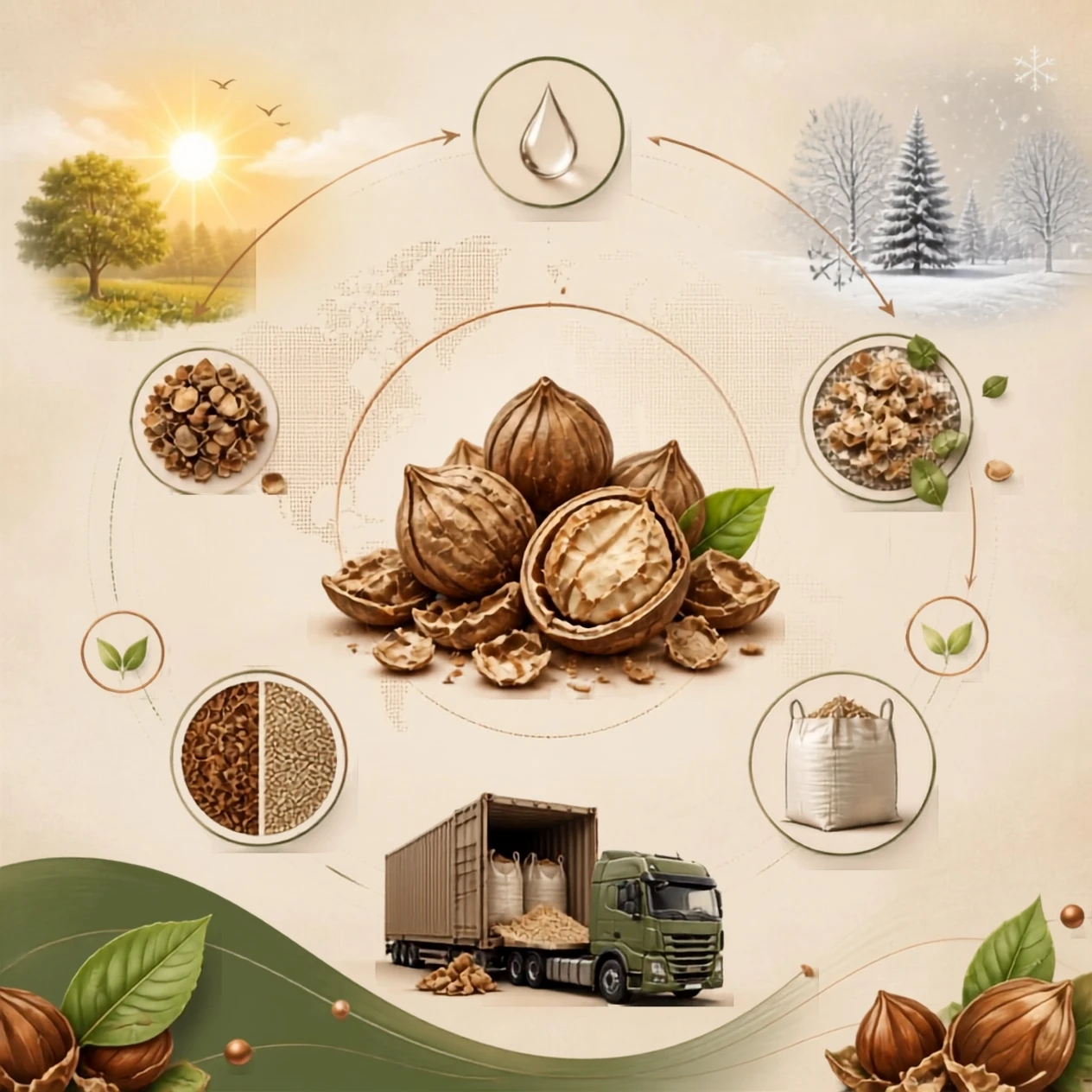
Hazelnut shell has no fixed list price; because it is a living product. It moves with the crop, moisture, delivery location, product form and season.
That is why price is not a fixed list updated once a year but a current figure evaluated together with stock, quality, delivery location and freight. We track supply and logistics conditions on the Ordu, Giresun and Sakarya line; we build the offer according to the requested tonnage, product form, packaging and delivery point.
Below we explain which variables make up that figure, so you can read the offer you receive and make your decision knowingly.
1. Crop
Shell is not an independent product but the output of the cracking industry. The crop sets the ceiling of supply.
According to Ministry of Agriculture and Forestry data, the estimated in-shell hazelnut crop was 739,000 tonnes in 2024, fell to 449,000 tonnes in 2025 with frost and adverse weather, and was announced as 704,000 tonnes for 2026. Given the yield basis, this means shell supply narrowed severely in 2025 and returned to normal in 2026.
Practical result: In narrow-crop years, price sees upward pressure and it also becomes harder to hold the same specification throughout the year.
2. Moisture
Moist shell carries less energy for the same kilogram. Water neither carries energy nor is free; it consumes energy as it evaporates.
So the price given from dry stock (5–9% moisture) and the price given from undried product are not prices of the same product.
For us moisture is not only a technical value but a matter of commercial transparency: water that carries no energy should not be sold to the customer as product. That is why the product's moisture is clearly stated in the offer and shipment evaluation; weight, energy value and price are compared on the same moisture condition.
3. Sieving and cleanliness degree
In unsieved shell, the ratio of soil, stone and dust rises. This both pulls the ash ratio up and creates problems in the feed line.
Sieved product costs more; but it means less cleaning and less downtime on the boiler side. The real cost of a cheap-looking unsieved batch emerges at the end of the season.
4. Delivery location
Shell is a bulky and relatively light load. Bulk density is on the order of 300 kg/m³; over long distances this enlarges freight's share of total cost.
A delivery close to the production region (the Ordu–Giresun–Sakarya line) and a shipment to the other end of the country produce a different total cost for the same product. This is not a matter of negotiation but the physics of logistics. That is why we work across all three provinces: if your delivery province is near the east, Ordu–Giresun comes in; if near the west, Sakarya.
Practical result: The question "what is the price per ton?" has no meaningful answer without a delivery location.
5. Packaging
The same shell enters a different price band when its format changes:
- Bulk (truck): The most economical per tonne. Requires an unloading area and equipment.
- Big-bag: Packaging easily moved by forklift and protected against moisture. The product weight per bag varies with the shell's particle size and grinding degree. Because unground shell is bulky, it does not reach 1,000 kg in a big-bag; this is not a shortcoming but the nature of a light, bulky material. That is why an order is spoken of by net tonnage, not by bag count.
- Sacks (25–50 kg): For retail and small consumption; the most expensive format per tonne.
When comparing offers, make sure the packaging is the same.
6. Particle size and grinding
Shell can be shipped in the raw form at the cracking exit and can also be prepared ground to request. This affects the price in two ways:
Processing cost up. Grinding takes energy and time; the finer the target particle, the more the cost rises.
Freight cost down. Because grinding increases bulk density, more product fits in the same bag, the same silo and the same vehicle.
So "ground is always more expensive" is not true. If your distance and purpose are clear, which one comes cheaper overall can be calculated.
7. Season
The seasonality of shell supply works inversely with heating demand:
- August–September: Harvest and drying. In-shell hazelnut circulates in the market; there is no shell yet.
- October–February: The busy period of the cracking season. Supply is here, moisture is low.
- March–July: Cracking slows, supply comes from stock.
Heating demand peaks in November. So the period of most abundant supply coincides with the period of highest demand.
8. Alternative fuel prices
Shell is used in heating as a substitute for coal and natural gas. When these fuels become expensive, demand for biomass rises and shell price sees upward pressure; when they cheapen, the pressure eases.
Exchange-rate movements also have an indirect effect: the fuel, spare-part and freight costs of cracking and processing plants move with the exchange rate.
What to write when requesting an offer
Six lines are enough for a sound and fast price:
- Annual or one-off tonnage
- Delivery province and district
- Product form and particle size (raw broken or ground; if ground, the target range)
- Packaging preference (bulk / big-bag / sacks)
- Purpose of use (boiler, oven, pellet feedstock, blasting, bedding, carbonization)
- Unloading capability (is there a forklift, can you unload a tipper)
A request that comes with this information can be given a firm price the same day. When information is missing, the other side quotes a wide band and you cannot compare.
How the current price is formed
To give the shell price correctly, three things must be seen at once: the cracking pace in the field, the current stock and that day's freight. All three require working close to the production region.
When supply, stock and freight are tracked together, the offer rests on delivery conditions, not on general market hearsay. For the buyer this means:
- The price is given the same day. A firm figure emerges when tonnage, delivery province, product form and packaging information arrive.
- The price rests on real stock. The price of goods not on hand is not given; the delivery date is clear from the start.
- Periodic planning is possible. For operations whose annual tonnage is set in advance, delivery and pricing conditions can be planned before the season begins.
The standard must be provided not only on the first batch. Running sieving, sizing, grinding and moisture control systematically reduces the variation between products shipped on different dates. Recording the quality, tonnage and delivery commitments given is a supply criterion as important as price.
Purchase timing
The soundest strategy for an operation with a set annual tonnage:
- Start the talks in late summer–early autumn.
- Lock the annual tonnage at the start of the cracking season (October).
- With full-truck shipments, make freight cheaper per tonne.
- Plan your storage capacity by volume, not by weight.
An emergency purchase made mid-winter is both the most expensive and the riskiest in terms of quality.
Sources: Ministry of Agriculture and Forestry crop-assessment data (2024–2026); TMO 2026/27 in-shell hazelnut purchase terms; ISO 17225-1:2021 solid-biofuel classification; ISO 17828 standard on bulk-density determination in solid biofuels.
Write your tonnage, delivery province, product form and packaging preference; we will give the current ton price the same day: get a quote.
Related content
- Technical Values and Applications
- What We Put in the Shipment: Specification, Packaging and Delivery
- Raw Hazelnut Shell; product page
Frequently Asked Questions
How is the price determined?
Hazelnut shell has no fixed list price; a quote is built from tonnage, delivery location, product form, packaging and season. Send your requirements for a current quote.
What are the heating value and moisture?
Higher heating value is around 18-19 MJ/kg, ash 1-3%, and moisture 5-9% in dry stock. These are literature bands; exact per-batch values are stated by analysis.
Why does ash matter?
Low ash cuts downtime for boiler and flue cleaning; a decisive factor in operating cost.
Isn't it pricier than wood chips?
The first cost per kilo may run higher than some mulches; because it decomposes slowly, annual cost is often lower; you don't renew it each season.
Ready to Explore?
Plan your next order with Fındıkkabuğu and see the difference yourself!
Browse Our Products